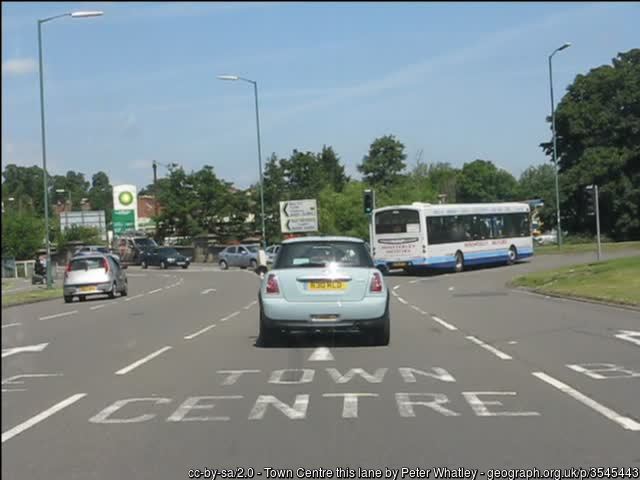
Read this and watch the video we made below, about Meole Brace, Shrewsbury. We explain the fascinating history and facts about the village of Meole Brace, which is situated on the Rea Brook, near Shrewsbury, Shropshire, UK. And, we do it in less than 2 minutes!
Meole Brace is a south-western suburb of Shrewsbury, Shropshire, England.
The Rea Brook, a tributary of the River Severn, flows through the area.
Locally the brook was, in the past, known as the "Meole Brook".
The name Meole Brace comes from an old Saxon manor house, which no longer stands, owned by the Brace family (perhaps originally 'de Bracey': Norman barons).
It has been known as Meole, or Mole, or Mill for almost 1,000 years; or possibly from the Welsh 'moel' meaning "bare", or by extension "bare hill" - or from Old English mele, "meal" as in "oatmeal", or possibly from the Welsh 'moel' meaning "bare", or by extension "bare hill" - or from Old English mele, "meal" as in "oatmeal", referring to the sediment in the brook giving a "mealy" appearance.
The A5112 (Hereford Road), formerly the A49, runs north-south past Meole.
The old part of Meole Village, lies on the route of a Roman road and could be even older than the town of Shrewsbury.
The village has a church, Holy Trinity Meole Brace.
Built at a cost of £7,500, it was consecrated in 1869 and is a Grade II listed building.
The ground, home of Shrewsbury Town F.C., is nearby.
Old St. Chad's Church Clock Chimes Struck at 4 am - WHAT HAPPENED THEN?
This is one of a series of videos about Shrewsbury Local History Events, and it took place in the 1780s.
Watch our video below for the answer, but don't forget to return afterwards to SCROLL DOWN this page for the full article.
A local stonemason was employed by the churchwardens of the Old Saint Chad's Church to mend some alarmingly large cracks that had appeared in the church.
As it was nearly midsummer he started work at 4am, and went to the sexton’s house nearby to collect the key.
While he did so the church clock struck 4:00.
The heavy movement, caused a vibration which was the final straw for the tottering structure, and, he, and two chimney sweeps working nearby noticed that the tower "suddenly opened".
It stood for a moment, as it were, suspended on the balance, and FELL; as it sunk, a cloud of dust rose so high, that for a while it concealed every surrounding object.
When the dust fell-away the whole area was spread with masses of stone, lead and timber, they lay in confused heaps, mingled with the shattered remains of pews, monuments, bells, and fragments of the gilded pipes and the framework of the noble organ.
The north side of the church had gone, while the whole of the south side of the tower hung in the air, with portions of its beams threatening destruction to any who would dare approach them,’ a contemporary wrote.
Furthermore, this need not have happened if the church authorities had listened to the advice, which was given previously by the young Thomas Telford, to start his recommended repairs, urgently.
In this capacity as County Surveyor he had previously been asked by the churchwardens of St Chad’s Church to report on some rather alarming cracks that had appeared in the building.
Telford had presented his report, ending with the words, “I think, Gentlemen, that if you have any other business to discuss, you would be wise to continue your meeting elsewhere, since this church may fall down on our heads at any moment.”
However the churchwardens chose to ignore the advice of the young Scotsman, and had employed that local stonemason alone to remedy the defects.
After much debate, the new St Chad’s Church was built near the Quarry, which stands to this day, but contrary to what you would expect Telford was not asked for advice on that.
Not that it mattered to him, because the fear of other medieval churches collapsing into oblivion, gave Telford lots of work, and he designed and oversaw the building of several new churches, in Shropshire at that time.
Attribution: Image of Old St. Chad's Church is by Richard Symonds (Own work) [CC BY-SA 3.0 (https://creativecommons.org/licenses/by-sa/3.0)], via Wikimedia Commons
English Civil War - Dramatic Seizure of Shrewsbury - Part 18 of the Story of Shropshire - The English Civil War 1642 to 1645
See Note 1 for attribution
The year of 1642 brought the horrors of the English Civil Wars, in which the Parliamentarians (led by men like Essex, Fairfax, and Cromwell) rebelled against King Charles I, whose government they considered to be arbitrary and oppressive.
Shrewsbury, like most of Shropshire apart from Wem, was strongly Royalist.
Watch our video below, but don't forget to come back here, after watching the video SCROLL ON DOWN THIS PAGE and tell us what you think, by commenting!
King Charles I visited the town in 1642, and Prince Rupert arrived and stayed for a few weeks in 1644. while Charles was there he recruited men for the disastrous campaign which later led to a Royalist defeat, in the famous battle of Marston Moor.
To prepare for any Parliamentary attack, the townspeople built additional fortifications which ran across the northern end of the town. Unfortunately, there does not seem to be any evidence of those walls still existing today.
These included a fortified wall, and a ditch which reached from the Castle all the way to the western loop of the River Severn, and another wall and ditch which should have reached all the way to the eastern loop.
Unfortunately, it didn't - and the gap was filled by nothing stronger than a few feet of wooden palisade.
Learning of this weakness from their spies early in 1645, the Parliamentarians at Wem entrusted Lieutenant-Colonel William Reinking with a force of twelve hundred men and instructed him to seize Shrewsbury.
Setting out from Wem by the light of the moon, on the evening of Tuesday 21 February, Reinking and his followers are said to have reached Shrewsbury at about 4 O'clock on Wednesday morning.
The main body of some eight hundred horsemen halted to the north of Castle Foregate, while the other four hundred dismounted, and made their way across the fields towards the wooden palisade by the river.
Reinking had brought carpenters with saws and axes to cut down the palisade, but when they arrived he was afraid that the noise of breaking down these fences would wake them, and alert the garrison to their presence.
So he launched a small boat on the River Severn, loaded it up with men, and told them to row it up-river and land inside the defences. However, the current in the river that day, was apparently too strong for them.
Twice they tried and failed to by-pass the defences in this manner; and then they were seen by a royalist sentry, who gave the alarm. They realised that, at that point, it was too late to worry about making a noise. So, Reinking and five of his men rushed immediately to the palisade, and broke it down.
That allowed the infantry to rush through the gap.
One group of fifty are said to have used ladders which they had brought with them to scale over the town wall where it ran along the riverside. Once through they dashed across the town to open the northern gateway.
But, Sir Michael Earnley led a small sortie from the Castle, in an attempt to prevent them from reaching the gateway. In the melee that took place his men were swept aside, and he himself was seriously wounded.
So it was, a few minutes later, the gateway had been captured. The drawbridge was let down, and eight hundred Parliamentarian cavalry were rode into the town virtually unopposed.
Meanwhile Reinking, at the head of the other three hundred and fifty men, who had streamed through the gap in the palisade, went forward to St. Mary's Watergate. In those days a tower and sentry point was attached to the Gate.
However, the guards, both at that location, and at another fort higher up the lane (where it was crossed by the town walls), were traitors.
A pre-agreed password was given by the invaders, and the guards immediately opened the gates. This allowed the Parliamentarian infantry to stream into the town.
They reached the street between the castle and the town, just as the cavalry came up.
Reinking was given a horse once again, and led an attack upon the 'Court of the Main Guard', which stood on the site of the present market square.
This was overcome after a short struggle in which it is said that Reinking had his horse killed under him.
Most of the royalist officers were taken in their beds.
That ends the story for us here. Miraculously, the total loss on both sides was only seven men and one captain, and the Roundheads had gained the town.
Text based upon The Story of Shrewsbury, by Richard Graves, Hardwick House, Ellesmere 1993.
This video (Part 17 "The Story of Shrewsbury") is about the fascinating period of Tudor Shrewsbury, when its Famous School (Shrewsbury school was started, and how Shrewsbury now at last has its own, new University. Finally, this video also lists famous past pupils of the Shrewsbury School. Watch the video below, but don't forget to come back here, after watching the video SCROLL ON DOWN THIS PAGE and tell us what you think, by commenting!
Much of the old Shrewsbury we know today, grew out of the wealth of the Tudor period.
As we showed in the last video, Shrewsbury flourished for over a century and a half of peace and prosperity.
It was also during this period that the importance of education was realised.
A petition in 1542 to Henry VIII from the townspeople of Shrewsbury for a free grammar school, led to the founding of Shrewsbury's best known school.
In 1552 Shrewsbury School was founded by the fifteen-year-old King Edward VI.
At first it occupied a house not far from the Castle.
Then in the 1590s and 1630s, it gradually expanded into the handsome stone buildings, which are now used as the Library, in Castle Gates, on the road from the station into the town centre.
It was not until many years later, in 1882, that "Shrewsbury School", by then badly in need of larger premises, moved to its present commanding heights, above the southern banks of the River Severn, opposite the park known as the Quarry.
Shrewsbury School is one of the, so called "original seven public schools", as defined by an Act in 1868, and 5 years before that the Clarendon Commission called it one of the 'great' nine schools.
Pupils are admitted at the age of 13 by selective examination.
It was originally a boarding school for boys.
Girls have been admitted into the Sixth Form since 2008. Since 2014 Shrewsbury School has been fully co-educational.
Shrewsbury School's "new site" of 150 acres (61 ha) in Kingsland, is where many famous "Old Salopians" were educated.
These include; The Right Honourable The Lord Heseltine CH PC (born 1933), politician.
Michael Palin CBE (born 1943), actor and TV presenter.
Nick Owen (born 1947), TV presenter.
Richard Ingrams (born 1937), journalist, founder of Private Eye.
Going Back! More Shrewsbury education history!
The Tudor period also saw the transition from wooden-framed buildings to brick and stone.
William Rowley built the imposing Rowley's Mansion in 1618. It is said to have been the first brick building in the town. William who was a draper dealing in Welsh cloth,
certainly created a lasting landmark for the town, and would no doubt have been proud of its new role.
Moving forward to today.
Rowley's Mansion has become one of the sites housing Shrewsbury's new university.
There are seminar spaces, postgraduate and general teaching spaces, and a University Centre help desk, all in the 16th century building.
Yes!
After so many years, the town no longer lacks a university.
Shrewsbury is still not yet officially a "CITY"- Shouldn't it be called a city?
Your comments are welcome!
But, for any viewers who have not recently visited, we can confirm that Shrewsbury is now a University town!
Historical text based upon: The Story of Shrewsbury, by Richard Graves, Hardwick House, Ellesmere 1993.
Now Watch Part 18: The horrors of the English Civil Wars...
During the 160 peaceful years, which began 1485, when Henry Tudor took control, Shrewsbury became a beautiful town.
It was during this period that the many successful cloth-merchants and wool-merchants, lived their prosperous lives. They built wonderful wood-frame buildings many of which survive to this day.
These were people like the Owens and the Irelands.
They built the wealth of black-and-white buildings for which Shrewsbury is now famous.
Watch our video to see these lovely old Shrewsbury merchants buildings, but when done, please do come back here, and scroll down to read more and comment on what you thought about our video:
The finest of these timber-framed houses is Ireland's Mansion, as seen here. (Ireland Mansion, Shrewsbury. A view up the High Street from Pride Hill.)
An imposing building, four stories high and finished with gables, dates from the 1570s.
On the left opposite the market square is another large half-timbered house.
The old market-hall of 1595 in the Square, remains another notable feature of the town, with its open arcades and an upper floor where, until not so long ago, the town's magistrates sat.
In Elizabethan times, the corn-market was held at ground level.
Built to replace an older building on the same site, it seems to be an early example of pre-fabrication, as it was reputedly built quite rapidly.
The stone-work and timber-framing was set up in less than four months.
Here is a selection of Shrewsbury's other black and white buildings...
These lovely buildings are just some of the remaining examples. There would have been many more in those days, before the 1960s.
Text based upon "The Story of Shrewsbury", by Richard Graves, Hardwick House, Ellesmere 1993.
Bye for now, but watch out for Part 17: Shrewsbury School starts and handsome Stone Buildings!
An eccentric showman associated with Shrewsbury was the daring Cadman. Read on to find out how he came to a horrible end.
This is a true story, from long ago where facts often seem stranger than fiction. If you need proof you can find it beside a Shrewsbury church doorway. Yes. Look on the outside of the west end of St. Mary's Church, which is opposite the Post Office at the top of the town, and you will see a set of verses commemorating his fatal accident in the year 1739. Watch our video below, about this first and then scroll down and please give us your comment on the event, and on our video:
Robert Cadman, was the man responsible for a sort of early circus act that went horribly, horribly wrong. Mr Cadman was a sort of Evel Knievel of the eighteenth century, a daredevil and an entertainer. He was steeplejack by trade, who performed feats of daring at various places across the country by sliding or "flying" down a rope.
It is recorded, for example, that he "amused the people of Dover, by flying across the harbour from the highest point of the cliff, towards the lower extremity of Snargate Street.
Thousands of people would assemble to watch these events.
Cadman's assumed rope position during his ill-fated "flight".
Anyway, on February 2, 1739, as part of Shrewsbury's celebrations of 'The Great Frost' that year, Mr Cadman was ready to attempt 'flying' from the spire of St Mary's across the River Severn and into the Gay Meadow.
In those days the Gay Meadow was just a meadow of course, and not a football ground!
Before beginning his epic rope-slide, he entertained the crowd below with a variety of rope stunts. But, tragically the rope snapped.
According to most accounts, one end of a rope had been fixed to the top of the spire of St. Mary's, and the other end to a point on the other side of the River Severn. Cadman, either balancing himself on a wooden box on wheels or holding a breast plate which ran along on the rope, he attempted to glide all the way down the rope.
But, suddenly, when Cadman was half-way across, the rope snapped, and he fell to his death. Some accounts say that his wife was so busy gathering money from the huge crowd of onlookers that it was several minutes before she realised what had happened...
Text for this article and the video from “The Story of Shrewsbury”, by Richard Graves plus additional information from Phil Gillam’s article in the Chronicle (newspaper), 11 January 2018 edition, and the Wikipedia, Robert Cadman page.
If you would like a video made for you similar to the one above, email steve@ippts.info and ask for details.
The story of Clive of India and how three Shrewsbury, Shropshire Streets came to be named.
Clive of India is a figure Shrewsbury residents are unsure whether to honour or to ignore. This is due to his chequered early life, and involvement with the East India Company, culminating in his taking his own life in suicide.
Robert Clive - Wikipedia
Major-General Robert Clive, 1st Baron Clive, KB, FRS (29 September 1725 – 22 November 1774), also known as Clive of India, Commander-in-Chief of British India, was a British officer and privateer who established the military and political supremacy of the East India Company in Bengal.
He is credited with securing a large swath of South Asia (Bangladesh, India, Pakistan) and the wealth that followed, for the British East India Company.
In the process, he also turned himself into a multi-millionaire. Together with Warren Hastings he was one of the key early figures setting in motion what would later become British India.
Blocking impending French mastery of India, and eventual British expulsion from the continent, Clive improvised a military expedition that ultimately enabled the East India Company to adopt the French strategy of indirect rule via puppet government.
Hired by the company to return a second time to India, Clive conspired to secure the Company's trade interests by overthrowing the locally unpopular heir to the throne of "Bengal," the richest state in India, richer than Britain, at the time. Back in
England, he sat as a Tory Member of Parliament in London.
Clive was one of the most controversial figures in all British military history.
His achievements included establishing control over much of India, and laying the foundation of the entire British Raj (though he worked only as an agent of the East India Company, not the British government).
For his methods and his self aggrandisement he was vilified by his contemporaries in England, and put on trial before Parliament. via Robert Clive - Wikipedia
In the mid-1700's the East India Company has power over commerce on the sub-continent, with the blessings of the British government.
A clerk in the company, Robert Clive, is frustrated by his lack of advancement, and transfers to the military arm of the company, where he excels.
Clive's leadership and gift for manipulation strengthen England's hold over India and lead to personal wealth, which is often threatened by the enemies he makes along the way. via Clive of India (1935) - IMDb
Clive, Robert, baron, 'Clive of India', 1725-1774
Clive, Robert, baron, 'Clive of India', 1725-1774 Born in Shropshire, Robert Clive gained a post as a scribe in the East India Company in 1743, but reached India (1744) deep in debt after a prolonged voyage out to India, after which he tried to shoot himself.
He quickly transfered to the military branch of the company, which was then engaged in the Carnatic Wars, and rose rapidly through the ranks, reaching captain by 1751. In the same year he was allowed to try out a plan for the capture of Arcot, capitol of the Carnatic, where he was then besieged.
The defense of Arcot (23 September-14 November 1751) made Clive's name. With just over 200 men, he held off a 10,000 strong attacking army, and once reinforced was able to go on the attack.
He was absent from India from 1753 to 1755, having returned to England to regain his health. In 1756, the new nabob of Bengal, Suraj Dowlah, broke his treaty with the East India Company, and occupied Calcutta, imprisoning the Company staff he found there in the Black Hole of Calcutta.
Clive commanded the land forced sent against Suraj Dowlah, and on 23 June 1757 defeated his army at the battle of Plassey, deposing him, and gaining control of Bengal for the East India Company, who appointed him governor of Bengal (1757-1760). via Robert Clive, Baron Clive, 'Clive of India', 1725-1774
Later, after Clive loses his seat in Parliament and all his money in the election campaign, and the doctor tells Margaret that their baby son will die within months, they return to India where madman King Suraj Ud Dowlah of Northern India has killed one hundred and forty-six English subjects by suffocation in the Black Hole of Calcutta.
Clive forges the name of Admiral Charles Watson to a treaty with Suraj Ud Dowlah's uncle, Mir Jaffar, because the timid admiral hasn't the courage to sign, and after receiving encouragement from Margaret, he launches a surprise counterattack with far inferior forces against Suraj Ud Dowlah.
The enemy counters using battle elephants, but Mir Jaffar's forces arrive and destroy Suraj Ud Dowlah's. Mir Jaffar, now king, presents Clive with a gift that allows him to retire to England.
Years later, Governor Pigot calls on Clive to return to India where chaos now reigns due in large part to the flagrant abuses of the East India Company directors via Clive of India (1935) - Overview - TCM.com
In declining health Clive went to England in 1760. He was given an Irish peerage, knighted, and made a member of Parliament. In 1765, when administrative chaos and fiscal disorder brought the company near disaster in Bengal, he returned to Calcutta as governor and commander in chief.
Clive limited the company to Bengal, Bihar, and Orissa, bringing these states under direct company control. He reformed the company's administrative practices, restored financial discipline while abolishing abuses, and reorganised the army. His efforts made the company sovereign ruler of 30 million people who produced an annual revenue of £4 million sterling.
Clive left India in February 1767. Five years later, in the absence of his strong hand in Bengal, the company appealed to the British government to save it from bankruptcy caused by widespread corruption.
Clive's enemies in Parliament claimed that he was responsible for the situation. After a long trial he was exonerated; but continuing attacks on his integrity, together with illness and physical exhaustion, led him to commit suicide in London on Nov. 22, 1774.
via Robert Clive facts, information, pictures | Encyclopedia ...